
How to Get Your B2B Company Into AI-Generated Answers
Updated October 2026
How Can a B2B Company Audit Its Presence in LLM-Generated Responses?
Ask ChatGPT, Claude, Gemini, and Perplexity the questions your buyers ask, then record whether your company appears and how it's described. Repeat monthly to see what changes. Gaps usually point to missing third-party coverage or unclear content on your site.
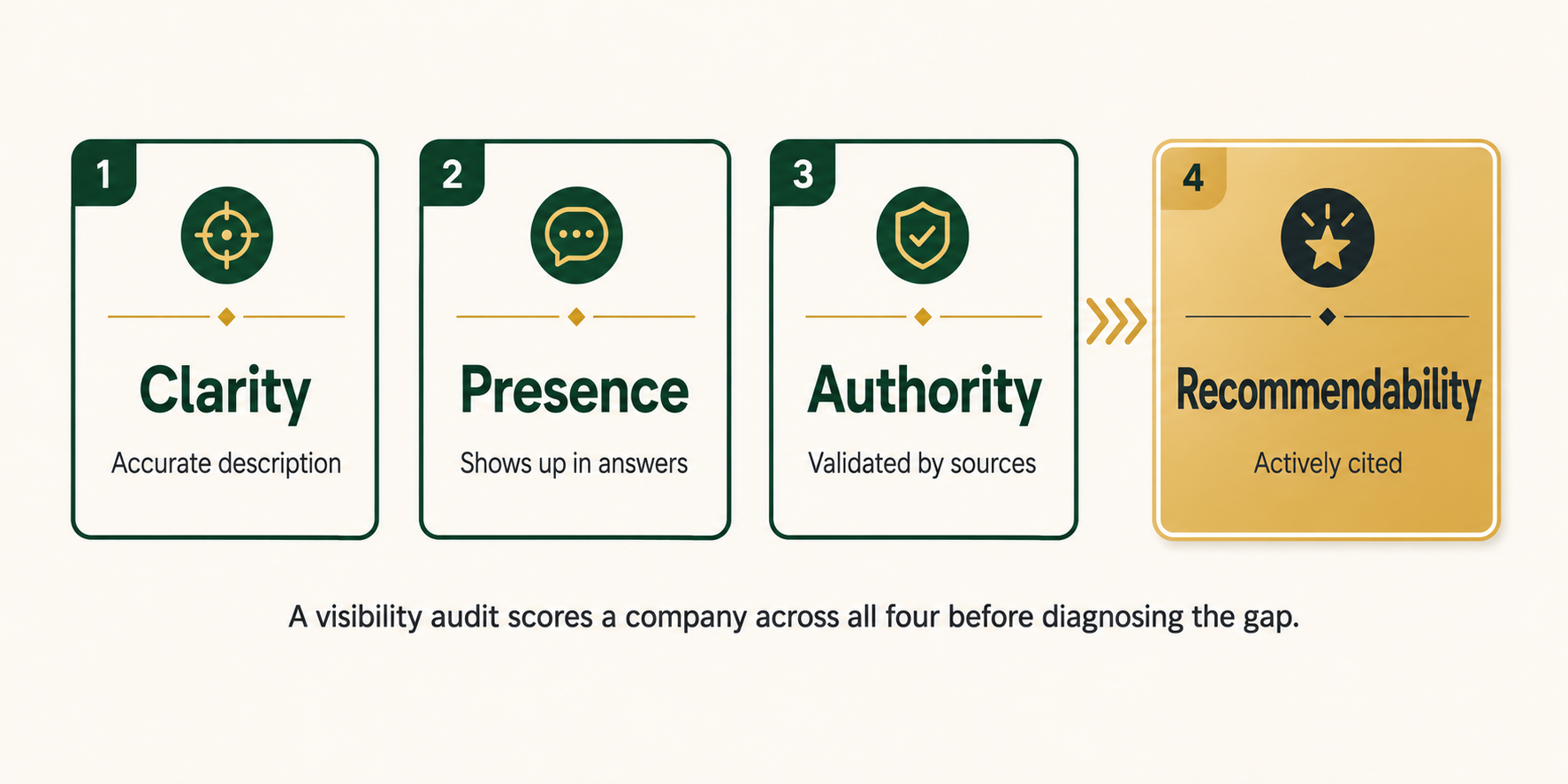
A complete AI visibility audit should evaluate four areas:
Clarity: Do AI systems describe the company and its category correctly?
Presence: Does the company appear when buyers ask relevant questions?
Authority: What sources are being used to validate the company?
Recommendability: Is the company merely mentioned, or actively recommended?
How to run the audit:
Build your question set. Pull 10 to 15 questions your actual buyers ask: category questions ("what are the best DLP platforms"), problem questions ("how can an enterprise prevent data loss through generative AI tools"), comparison questions, and direct "what does [company] do" queries.
Test across engines. Run the same questions through ChatGPT, Claude, Gemini, and Perplexity. Use incognito or private browsing mode, or log out first, so account memory and browsing history don't influence the results. Start a new conversation each time so answers aren't shaped by prior context in that thread. Consider running each question three to five times in separate sessions, since AI answers vary from run to run.
Record what happens. Note whether the company appears, whether the description is accurate, and whether any source is cited to support the answer.
Compare against competitors. The most useful finding often isn't "we didn't appear." It's which competitor did, and what let them show up instead.
Repeat monthly, or sooner around a launch, repositioning, or media push, since answers can shift as these systems update.
AI citations are not permanent. Recent research found that the median page lost half its peak citation share about 11 days after peaking, though pages that sustained their citations held up for roughly four weeks. (Source: Profound) The lesson is that visibility has to be maintained, so audit regularly and keep publishing specific, useful content. In addition, the study found that pages cited by five or more engines were far more likely to keep their citations. In other words, content that holds appeal for multiple AI engines is more likely to have a longer citation life.
What is an LLM, and how do they recognize your company?
It may help to go technical and examine how large language models (LLMs), or an AI system trained on large amounts of source data to understand context and provide answers, work to retrieve answers. Common LLMs include Claude, Grok, ChatGPT, and Gemini, and these systems rely on training data to answer queries, although some can access web searches in real-time. Perplexity is a slightly different model, built around real-time web searches but using an LLM to synthesize its results.
Because LLMs are trained mainly on existing web content, when someone asks an AI about a company or category, the system draws on the signals present in training data to provide an answer. The training data can include a company’s earned media, authoritative mentions, company rating lists, and third-party validations. A company that has a strong earned media presence, involvement with analyst groups like Gartner or Forrester, presence on company ranking sites, and executive thought leadership in speaking opportunities or op-ed placements, will have a better chance of being mentioned.
What if a company is not in an LLM’s training data?
Many companies may not have a strong presence, or any presence, across these touchpoints. Or a company may use different taglines, descriptors, and benefits across external validators, which confuses the LLMs. When these situations happen, LLMs can react in a few ways:
The AI ignores the company: Let's say someone asks, "what are the best cloud security posture management tools?" This is the best description of the company's current offerings, but the company has a history of being ranked as a top data loss prevention (DLP) solution provider.
The AI does not see strong signals around the company being a cloud security posture management tool, so it does not include the company in the responses.
The AI gets the company wrong: There could be a situation where there are equal amounts of signals around a company being a cloud security posture management solution and a DLP provider. The AI uses the information to the best of its ability and categorizes the company as a DLP company that has cloud security posture management capabilities.
This categorization downplays the true abilities of the company's solution to potential buyers.
The AI can’t recommend the company: Let’s say the LLM has enough of a signal to rank a company as a cloud security posture management company, but not enough to give a robust response. The LLM could give a sparse answer or say that it does not have enough information on the company (if someone asked for your company by name).
Build your LLM presence
If your company is not actively building signals for LLMs, you are either missing from AI answers or being described inaccurately. The process requires time, strong content, and visibility across touchpoints.
First check: Common Crawl
The Common Crawl dataset is a primary source for training LLMs. If a company’s site is crawled and included in a Common Crawl snapshot, there's a better chance that its content becomes part of the LLM "knowledge” for training and later fine-tuning. You can’t submit your site to Common Crawl, but you can make your site easier for crawlers to find and index. Crawlers like Common Crawl like sites that are fast, cleanly structured, easy to navigate via internal links, and backed by a current XML sitemap. Your site needs to allow crawlers, too. Many companies unwittingly block the CCBot Crawler, which makes them undiscoverable to Common Crawl.
Second check: LLM-friendly content
Once your site is crawlable, the question becomes whether your content is the kind AI systems want to surface. Based on current GEO research and our own work with B2B technology clients, here’s what matters most:
Structure matters more than length. LLMs parse content that is organized clearly into short paragraphs, descriptive subheadings, and answer-first formats. Dense walls of text get deprioritized. The best way to approach the structure is to think of how your CEO would answer a question from a senior customer prospect and use that style to structure the content.
Data and authoritative elements increase your chances for LLM inclusion. Content that includes specific, quantifiable results will always outperform vague claims. A stat like 'a company using best GEO practices saw a 113% increase in LLM presence over nine months' gives an LLM something concrete to cite. 'Good GEO practices can increase your presence in as little as nine months' gives the LLM nothing.
In-depth material beats a large volume of high-level material. AI systems recommend sites that demonstrate genuine expertise in a specific area. A few deeply researched, well-written pieces in a company’s core category will outperform dozens of thin posts optimized for search keywords. This shows the difference between GEO presence, LLM rankings, and SEO. SEO rewards keyword presence, and the more that are there, the better for SEO. LLMs are looking for demonstrated topic expertise.
Clarity around what your company is and does. Your company’s purpose and offerings should be apparent and clear across your website, third-party citations, thought leadership pieces, and earned media. The more clearly your content defines who you are, what category you occupy, and how you relate to the broader ecosystem of your industry, the better AI systems can place you accurately in generated answers.
Earned Media Is Still the Most Powerful LLM Signal
Here is the thing that often surprises B2B marketers: the single most effective way to increase AI visibility is not website optimization. It is earned media.
When your company is cited, quoted, and referenced in credible third-party publications, AI systems treat that as corroboration. A quote in a tier-one technology publication, or a mention of your company as one to watch in a business publication, is valued highly by LLMs. The signals AI systems trust most are the ones that human audiences have always trusted: coverage, citation, and independent validation.
What to Do This Quarter (Q4 2026)
We are in the fourth quarter of 2026, and here are practical actions to get your company primed for LLM visibility in 2027:
Audit your current AI presence. Start by asking Claude, ChatGPT, and Gemini about the best provider for X, using the category in which you want inclusion. Then, ask about your company by name as well as your competitors. Record what they say as well as its accuracy. Note where you are missing or misrepresented. This baseline shows your signal gaps. You can build an action plan to close these gaps.
Check your technical foundation. Make sure your site is crawlable, fast, and structured clearly. Remove any blocks on AI crawlers. Add schema markup where relevant.
Submit your sitemap to Google Search Console and Bing Webmaster Tools. Doing so won't get you into Common Crawl directly, but it strengthens the overall discoverability signals that do.
Build a content strategy that prioritizes in-depth knowledge. Take the two or three questions your best prospects are asking AI systems right now on the problem you solve and create authoritative, well-structured content that answers them definitively.
Invest in earned media. Get to know the top reporters who would cover your company in the technology, business, industry and broadcast media. Look for ways to engage them such as sharing trend data you have. The most important thing to note about earned media is that you have to adopt a reporter's mindset for the interaction. Many companies are stuck in sales mode and want to publicize their solution’s abilities. The reporter wants to share data and trends with their readers, and these readers will stop reading anything that looks like a sales pitch. LLMs love earned media.
The companies building these programs now will have a meaningful advantage in 2027. AI visibility is not a future problem. It is a present one.
Anne Coyle is the founder of Coyle Emerald Narratives, a Boston-based B2B technology consultancy specializing in Generative Engine Optimization and AI visibility.
Frequently Asked Questions
How can a B2B company audit its presence in AI-generated answers?
Plan the audit to measure the signals LLMs respond to: clarity, presence, authority, and recommendability. In short: build a set of buyer questions; test them across ChatGPT, Claude, Gemini, and Perplexity; record whether your company appears and how it's described; and then compare those results against competitors.
What content format, structure, and depth does a B2B company need to appear regularly in AI answers?
It is important to note that format matters more than volume. AI systems favor short paragraphs, descriptive subheadings, and answer-first writing over dense blocks of text. Write the way a CEO would answer a question from a senior prospect, and not the way a keyword-optimized, SEO-primed landing page reads.
For topics, go deep instead of wide. A handful of well-researched pieces that fully cover the two or three questions that prospects are actually asking will outperform dozens of thin posts targeting related subjects. This depth is the core difference between GEO and SEO: SEO rewards keyword coverage, and GEO rewards proven expertise.
Remember the importance of data. A stat like "GEO practices increased LLM presence by 113% over nine months" gives an AI system something concrete to quote. A claim like "good GEO practices increase your visibility over time" gives the AI system a vague statement that will likely be ignored.
Format, topic focus, and specific evidence work together. A well-structured page on the wrong topic still won't get cited, and a deep topic buried in dense paragraphs won't get parsed correctly either.
What is the difference between being fetched and being cited by AI?
Being fetched means an AI engine visited and read your page. Being cited means the AI named or linked your company in its answer to a user's query. Many pages get fetched but never cited, so traffic from AI bots is not the same as AI visibility. To close the gap, make sure your content directly answers buyer questions in plain language the AI can quote, with your company's name cited on the page where the answer lives. That is one step toward turning a fetch into a citation, but your company still has to be matched by third-party validation before the AI will actually cite you.
How do I get my B2B company cited by ChatGPT, Claude, and Perplexity?
There is no formula for the right volume or amount of time that will result in your company getting cited in AI Search. Publishing good content over an extended period does not automatically move you up in the citation process the way it might in search rankings.
The AI models are not counting your posts or marking the length of time you have been publishing. They crawl your site to see whether your value proposition, products, and services are clearly stated. They also crawl the rest of the web to see what perception independent, third-party sources have about you. This third-party content, such as earned media, analyst reports, and credible reviews, tells the models this company is real in a way your own pages never can.
Similarly, there is no method to measure the best mix of company content and third-party mentions that will make you appear more in citations. Getting there is a result of three things: knowing exactly where your gaps are, closing the gaps with clear content on your site, and pressing hard to get independent third parties to recognize you in your category. Do all three, because any one of them alone rarely earns the citation.
Does SEO help you appear in AI-generated answers?
SEO helps you get found by search engines, but ranking on Google doesn't guarantee you'll appear in AI answers. AI engines cite pages that directly answer questions in a quotable, verifiable way, which is a different standard from ranking for keywords. Some of the elements used for SEO are useful for AI answer engines. They like well-structured sites: clear headings, direct answers near the top, concise quotable sentences, descriptive links, and clean markup like schema. But structure only helps the AI understand what your company is. It does not earn you the citation. For that, the AI looks to independent third-party content to confirm you are who you say you are.
How do I measure if AI engines are citing my company?
You can't tell from logs alone. Server logs and analytics tell you when an AI bot has fetched your page or sent a referral, but fetching is not the same as being cited.
To measure how AI engines view your company, regular prompt checks across Claude, Perplexity, ChatGPT, and Gemini are essential. Try these: "What is [company name]?" to see if the AI engines give you a clear description that matches your value proposition. Conflicting answers are most often due to web pages or third-party citations with differing value propositions or descriptions, which confuses the AI engines. "What are the best tools or solutions for [your category]?" and "Who are the top providers for [your category]?"
Check where your company appears, and whether the description matches your value proposition. Check which competitors appear as well as how they are described. In addition, check analytics for referrals from perplexity.ai and chatgpt.com, and watch server logs for AI bot user agents. These confirm AI engines are reading you.
If your citations do not match the level of bot activity on your site, there is something wrong with how the AI engines are perceiving you. Common reasons are unclear descriptions on the website and a lack of third-party validation signals.
Our competitor gets called "industry-leading" in AI answers, and our company gets described as "an alternative." Is there a way to change that?
Yes, but it takes deliberate work over time, rather than a quick fix. AI systems form these labels from the language they see repeated across your public footprint: press coverage, analyst mentions, comparison content, and your own site. If your competitor's category-leader framing appears consistently across those sources, and yours doesn't, the model defaults to reinforcing them as the leader.
Closing that gap means building a body of third-party content that states your position directly and consistently, not just implying it through marketing copy. That includes earned media that uses strong positioning language, analyst or industry mentions, and comparison content where your differentiation is stated plainly rather than left for the reader to infer. Consistency across sources matters more than the strength of any single mention.