
What Is GEO? How AI Decides Which B2B Vendors to Recommend
B2B technology customers are using AI systems (ChatGPT, Gemini, Claude, Perplexity, Microsoft Copilot, Google AI Overviews) to ask questions that once went to search engines: Which vendor should I evaluate? What platform is best for my use case? Generative Engine Optimization (GEO) is now the discipline that determines whether a company appears in those answers, or doesn’t.
GEO vs. SEO: Same Goal, Different Signals
To understand GEO, it is helpful to see it in the context of Search Engine Optimization (SEO), which dominated discovery over the past few decades. Search engines find and rank pages, and SEO is how companies optimize for that. AI systems evaluate content to understand, validate, synthesize, and recommend, which is a fundamentally different process than search ranking and is driven by different signals. The companies most likely to appear in AI-generated recommendations are not necessarily the largest, the longest-established, or those with the best SEO. They are the ones whose credibility, category position, and expertise are consistently and repeatedly confirmed across trusted external sources.
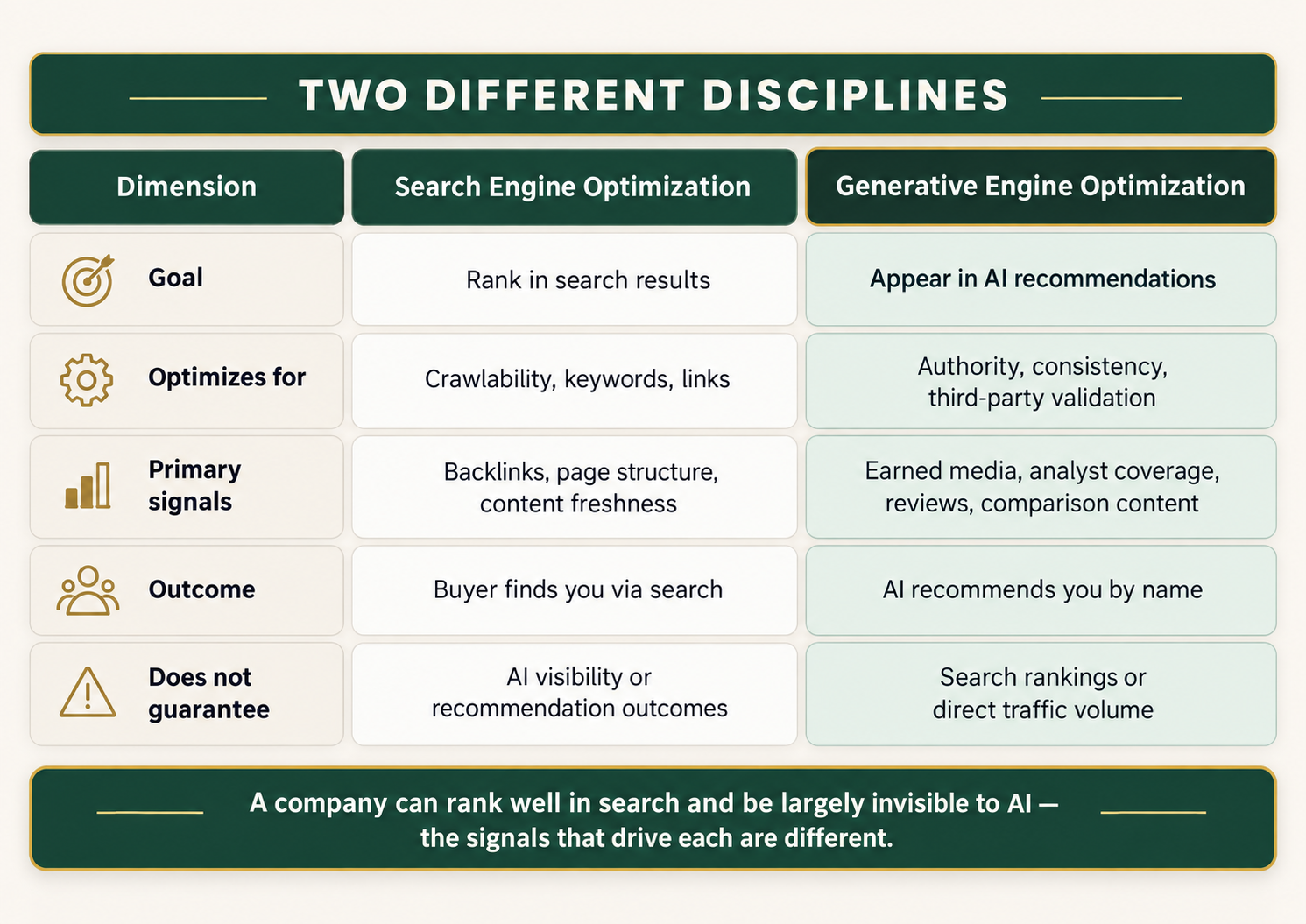
SEO vs. GEO: a breakdown
The Four Signals for GEO Presence
AI systems rely on signals to decide which companies to trust and recommend. These signals fall into four categories:
Category signals: Category signals tell AI what a company does and who its competition is. Category signal examples include language used to describe a company and its products, clear problem/solution content on its website, and structured content that mirrors AI queries.
When category signals are strong and consistent, AI systems can confidently and accurately place a company competitively. Weak or contradictory category signals can cause AI systems to choose the wrong category or reduce their confidence in mentioning the company at all.
The category signal test is simple: search for every external mention of a company and note the descriptions. The more variety in the description, the more confused the AI system becomes.
Authority signals: Authority signals aid AI systems in determining whether a company is recognized by valid third parties as having expertise. Examples of authority signals include:
Earned media placements in credible technology and business publications, which represent credibility at scale
Bylines and op-ed articles enable AI systems to associate a company with thought leadership
Analyst mentions (Gartner, Forrester, IDC) show AI systems that a company has gained credibility in the analysts’ rigorous vetting and review processes
Authority signals don't happen by accident: they're the cumulative result of coordinated media, analyst, and thought leadership activity over time. The companies that build these signals contribute original perspective to industry dialogue rather than restating consensus. In analyst relationships, especially, openness pays, and vendors who engage candidly with their own positioning earn more substantive, specific coverage. This level of specificity is exactly what AI systems use to establish credibility.
Validation signals: Validation signals provide independent confirmation that the market is responding to the company’s products or services. These signals are powerful for AI systems in recommending a company, and examples include industry awards and recognition; customer reviews on platforms like G2, Gartner Peer Insights, and TrustRadius; certifications; and structured third-party assessments. Unlike earned media, many validation signals carry structured data, such as star ratings, category rankings, or verified buyer status. AI systems can parse these validation points with high confidence. A company that has never been independently evaluated simply does not have these signals, and that absence is visible to AI.
Comparison signals: Comparison signals determine which companies AI puts on the shortlist and which it leaves off entirely. When buyers ask AI to evaluate options, identify alternatives, or rank platforms by use case, AI draws on buyer guides, competitive comparisons, alternatives pages, and ranking content to construct its answer. That content becomes the evaluation set for comparison signals. Presence here is binary. Companies that appear consistently in comparison environments get recommended. Companies that don't appear are effectively invisible in AI shortlists, however strong their product or brand.
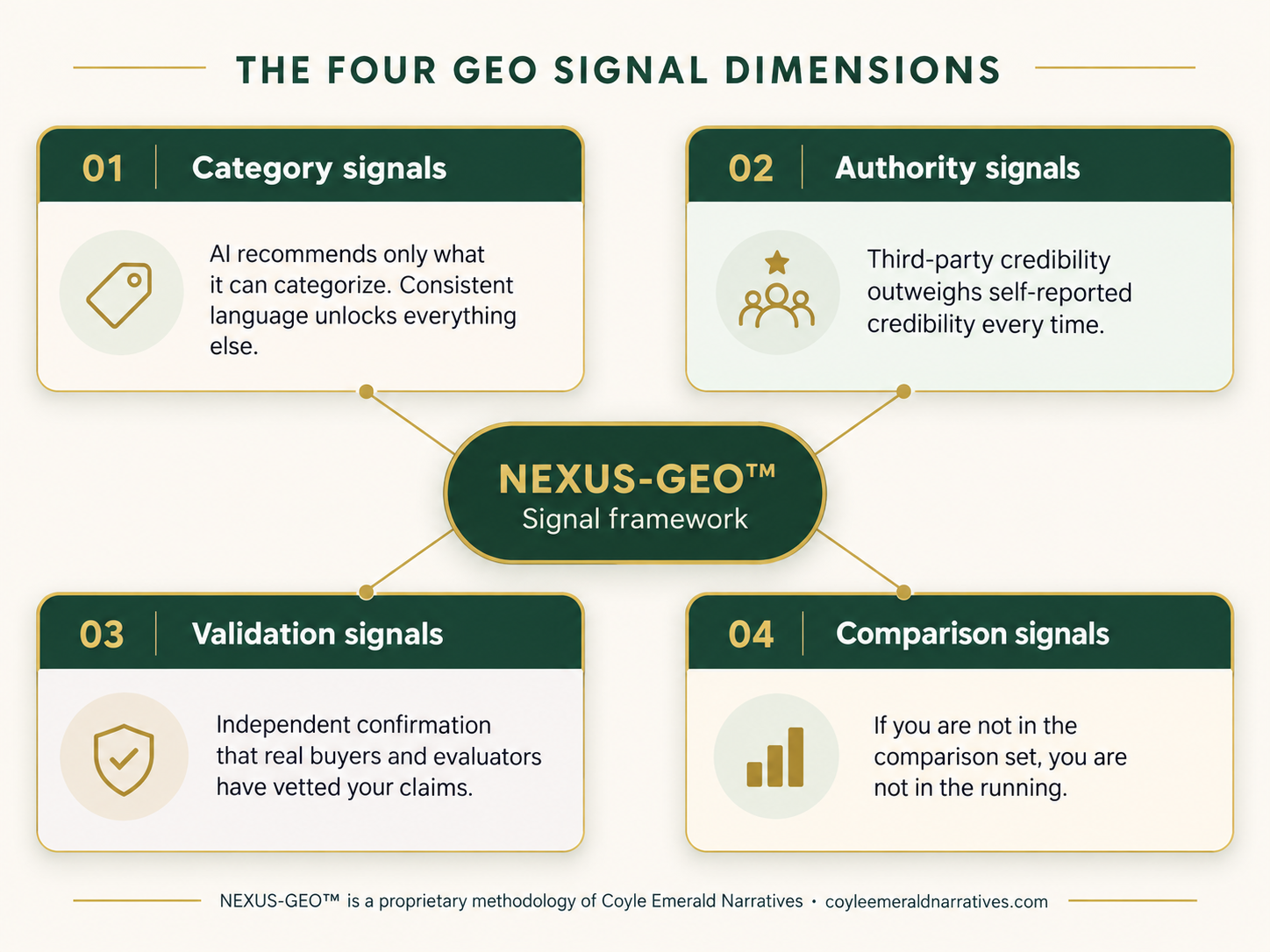
GEO responds to four signals
How to Build Your GEO Signals
Start with category signals: they unlock everything else.
Authority, validation, and comparison signals only work if the AI system already understands what a company does. A Forrester mention means more when the category language around it is consistent. A G2 review is more powerful when the product description on the review platform matches the product description on the company website.
Before investing in external signal building, audit the basics: how is the company described on its own website, in its press coverage, in analyst mentions, and in third-party listings? The more variation in that language, the more foundational work needs to happen first.
Build authority signals through coordinated external programs.
Strong earned media, executive thought leadership, and analyst engagement don't happen by accident: they require planned, sustainable programs. A typical program will include outreach to credible earned media, developing executive points of view, and engaging analyst firms with openness and preparation that results in meaningful coverage.
This is one area where quality means more than quantity. A single placement in a tier-one publication carries more GEO weight than dozens of syndicated press release pickups.
Activate validation signals systematically.
Customer reviews, awards, and third-party assessments are among the most underutilized GEO assets in B2B technology. Many companies have satisfied customers who would leave a G2 review if requested, but no one asks. An awards calendar, a structured review request process, and proactive engagement with certification programs are all within reach for most companies.
Build comparison presence deliberately.
If a company does not appear in comparison content, such as buyer guides or competitive roundups, it will be less likely to appear in AI-generated shortlists. This is one of the most actionable GEO gaps to close.
The window is open, but not indefinitely.
GEO is not yet a standard discipline. Most B2B technology companies are not managing their AI signal ecosystem deliberately. That creates a genuine window of competitive advantage for companies that move now.
Companies that establish strong category signals, build credible authority, accumulate validation, and appear consistently in comparison environments will be the ones AI recommends to the buyers who are already asking.
Ready to act on this? See How to Get Your B2B Company Into AI-Generated Answers.
Anne Coyle is the founder of Coyle Emerald Narratives, a Boston-based B2B technology consultancy specializing in Generative Engine Optimization and AI visibility.