
AI Visibility for Cybersecurity Companies
You know AI visibility matters. The question is timing.
Cybersecurity buyers now research a shortlist of vendors using ChatGPT, Claude, Perplexity, and Gemini instead of asking a colleague or opening an analyst report. For most security categories, these AI answers are still taking shape. The companies that AI systems can describe clearly and cite confidently are more likely to remain the default in AI answers. Waiting to improve your AI presence risks letting a competitor become the default.
Why do AI systems have a hard time with the security industry?
Most GEO advice asks a company to describe itself in one clear sentence. Security companies can do this, but their differentiation lives in the details: detection method, deployment model, data handling, compliance posture, and integrations. Technical buyers trust that depth, and you don’t have to sacrifice it for GEO visibility.
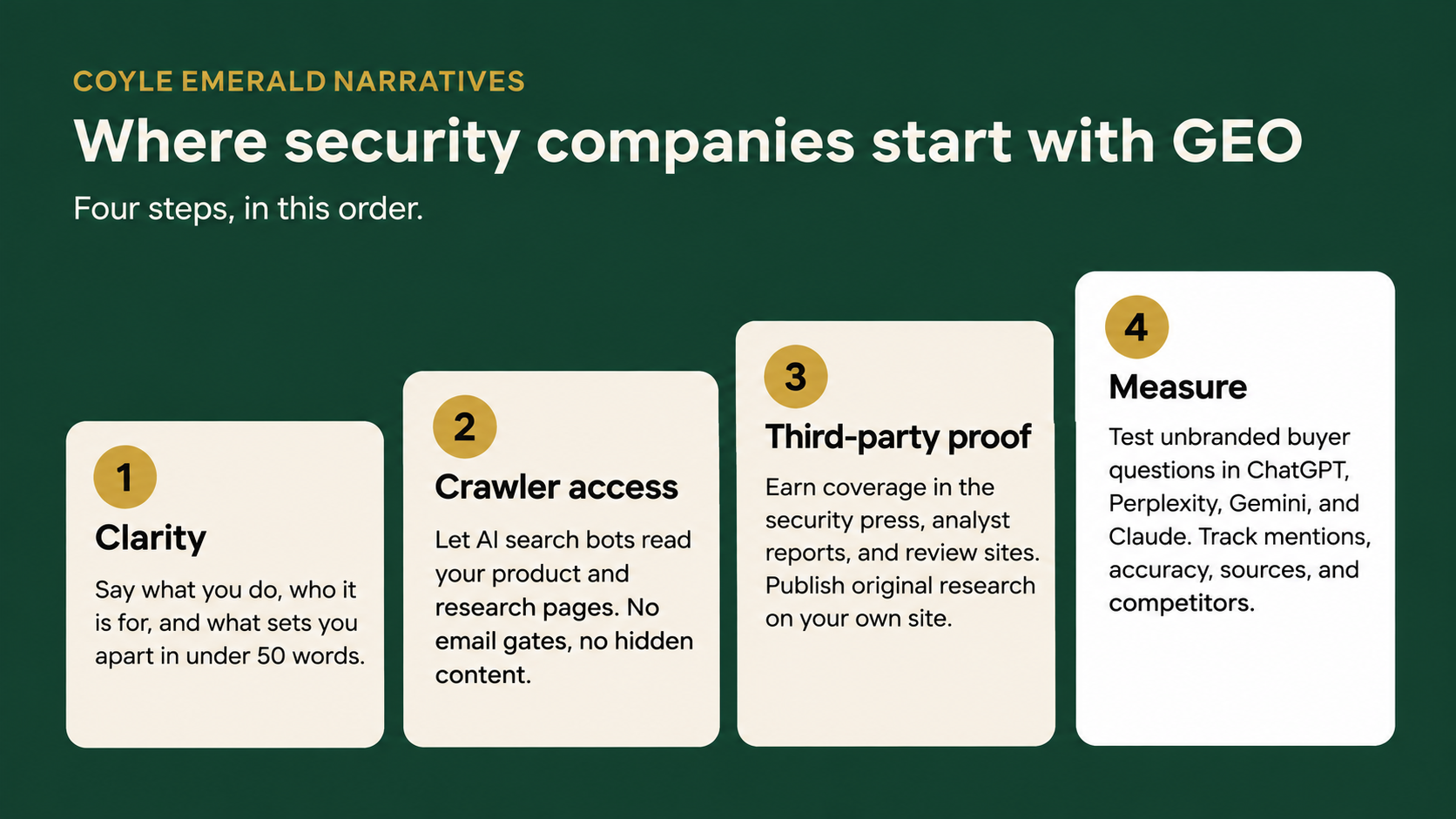
What should security companies prioritize for GEO visibility?
Clarity
Clarity comes first. State your category, who it’s for, and your key differentiators in plain language near the top of core pages, in under 50 words, with your deployment model and integrations spelled out. Put technical depth and details under this opening section. You may find some similarities with SEO when reviewing your content for clarity, but GEO is different and relies on different signals.
Crawler access
Make sure your firewall and robots.txt allow AI search bots, and that product and research pages aren’t hidden behind email gates or content that only loads through JavaScript. If AI can’t read the page, nothing else matters. If you don’t want to publish your entire product or research library publicly, put a short public description on each asset’s landing page.
Third-party validation
Third-party validation and original research are two ways security companies can increase their visibility in AI answers. Validation comes from earned media, analyst firms, and review sites like G2. A regular presence in earned media, especially the security press, signals to AI systems that the industry trusts your insight. Publishing original research on your own site also sets you apart from competitors and gives AI systems more data to draw on when they describe you.
Where should security companies start with GEO?
Start by measuring and recording your GEO presence immediately. Test unbranded buyer questions across ChatGPT, Perplexity, Gemini, and Claude, and track whether you’re mentioned, how accurately you’re described, and which sources get cited. Also note which competitors appear in the answers. Make the prompts mirror your buyer’s questions and journey.
What we found in the security benchmark
In a July 2026 NEXUS-GEO™ benchmark of five data loss prevention vendors, none reached the Leader threshold of 64 out of 80. The top score was around 60, so no company had yet made the case clearly enough for AI systems to recommend it with confidence.
What waiting can cost
Once AI systems settle on a set of vendors for a type of question, that pattern can be hard to move. The companies that establish themselves early are not always the strongest companies; they just were on the AI systems’ radar earlier. Companies that treat GEO as a someday problem risk losing valuable time.
When does GEO matter most for security companies?
Most security vendors come to us at one of these moments:
A new funding round. You have raised and need to own your category before competitors do.
A repositioning or new module. AI answers still describe the old version of your product.
A competitor in the answers, and you are not. They appear when buyers ask ChatGPT or Perplexity for a shortlist, and you do not.
An analyst briefing ahead. You want analyst coverage to carry through to how AI systems describe your category.
Falling organic traffic. Search is shifting to conversational answers and your content is not following.
See where you stand
NEXUS-GEO™ is an 80-point diagnostic across four dimensions: AI Clarity & Structure, AI Visibility & Narrative Presence, Authority Signals, and AI Recommendability. It shows where your own language works against you in AI answers.
A short call is the lowest-commitment way to see where you stand.
FAQs
How do security buyers use AI to choose vendors?
Many ask ChatGPT, Perplexity, and Gemini to shortlist vendors and compare options before they contact sales. Whether your company is named, and how it is described, shapes who gets considered.
What is GEO for a cybersecurity company?
Generative Engine Optimization (GEO) is the work of getting your company seen, understood, and cited or recommended by AI systems when buyers ask category questions.
Why is AI search harder for security vendors?
Security differentiation is technical and layered, so it is hard to compress into one accurate sentence. Vendors with dense, overlapping language are easy for AI systems to confuse or skip.
What is NEXUS-GEO™?
NEXUS-GEO™ is an 80-point diagnostic of how AI systems understand and recommend your company, scored across four dimensions. A score of 64 or higher marks a Leader.
Can you guarantee my company will be recommended?
No. AI answers vary by engine and change over time. We diagnose and improve what you can influence: how clearly you describe yourself, the third-party authority behind you, and how recommendable you look.
Who is this for?
B2B cybersecurity vendors in cloud, identity, and data security, MDR and MSSP, and GRC and compliance, where a founder or marketing leader makes the call.