
Many companies put in intensive, detailed work to be visible in a buyer’s first AI prompt. This is because nearly all business buyers (94%) now use AI during their buying process, according to Forrester's State of Business Buying, 2026. Think, “What are the best [category] vendors?” However, many B2B buyers continue past the first question to a prompt that adds qualifications, such as "Which of these companies can meet compliance standards and go live within 90 days?"
The second question could push your company off the shortlist if the AI engine can't find these details about you. The fall-off is known as “conversational churn,” and your AI engine strategy should include information to keep your brand visible through the second and third buyer questions.
Why brands drop off the AI search shortlist
A brand that has mapped its content for AI engine visibility, achieved third-party validation, ensured consistent messaging across all online surfaces, and engaged with media and analysts has a shot at making the “best vendor” shortlist. When a buyer asks for more qualifying information about the companies on the shortlist, the buyer sees only the companies the AI engine can qualify. Companies that keep information such as capabilities by industry, case studies, ROI reports, or pricing models behind gates get dropped. The AI engine could not find data to verify that the company had these capabilities, so it makes the safe choice and excludes it in the second round of recommendations. The risk is that a competitor that also made the shortlist moves on to the second round because it made its information easy to find.
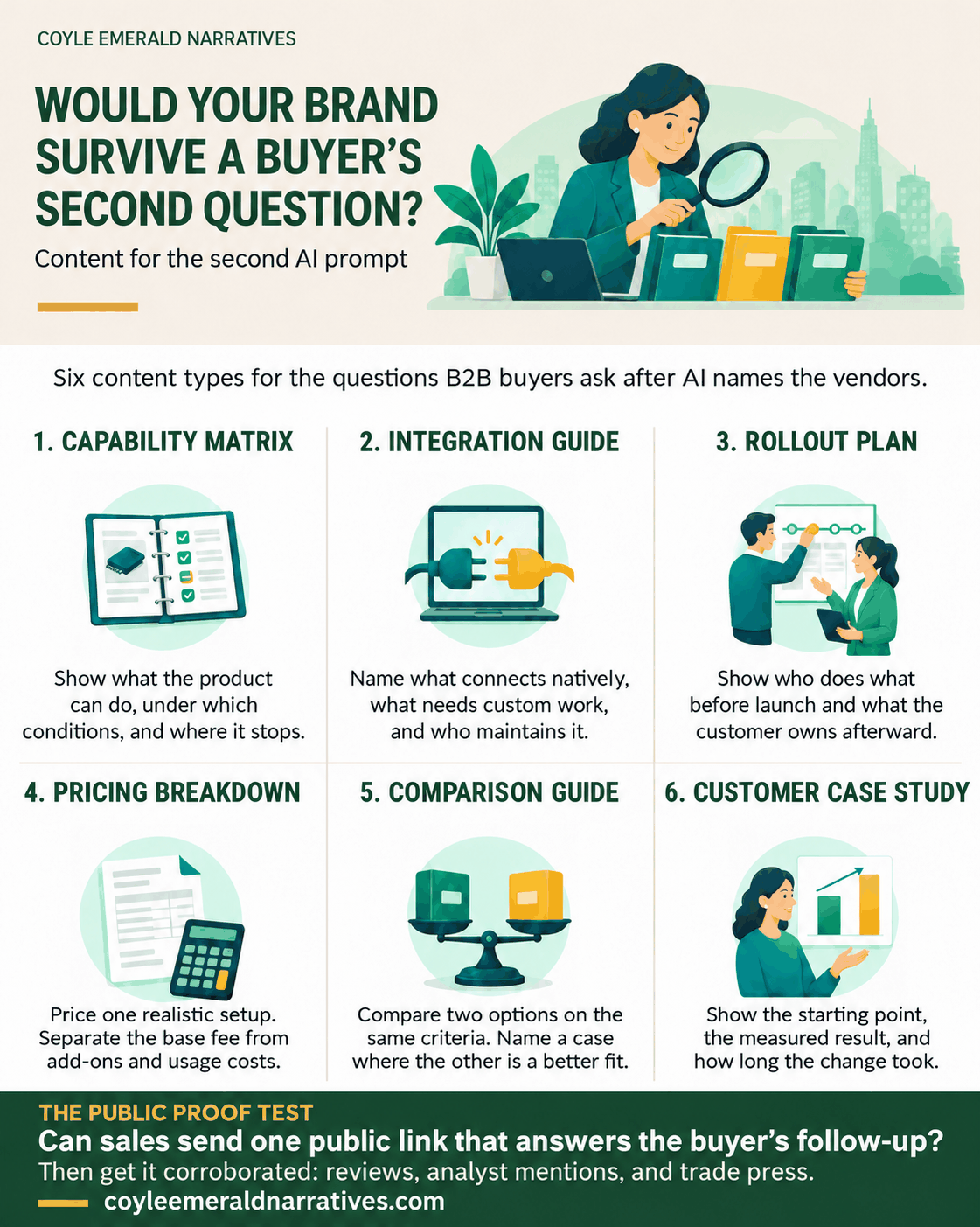
What content keeps a B2B brand on an AI shortlist?
There are six content types that, when used together, give AI systems a sense of your capabilities, especially for the second question.
Capability matrix. This shows what your product can do, under which conditions, and where it stops working, so that benefits and limitations are clear. Second question: “Which of these companies support [situation detail] for a company of our size?”
Integration guide. This is a detailed list identifying native connections, connections that need customization, and how both are maintained. Second question: “Which of these companies integrate natively with Salesforce?”
Rollout plan. This information details a typical rollout for your product, including what is needed from the customer, what you provide, and a sample timeline. Ideally, it will include how updates are managed and what you and the customer own post-implementation. Second question: Which of these companies can go live in 90 days?”
Pricing breakdown. This is an important list, even if your pricing can vary widely by implementation. Publishing one basic pricing model that separates the base fee from add-ons and usage costs gives the AI system a baseline. Second question: Which of these companies costs $50,000? Are there annual service costs?”
Comparison guide. This is a published comparison of your company against named competitors. This would rank you and others fairly, including conditions in which another company would be a better fit. For example, you might rank your company highest for cybersecurity clients and rank a competitor highest for large, general implementations. Second question: How does [your company] compare with [a competitor] for servicing a mid-sized cybersecurity company?”
Customer case studies. These show the starting point, the measured result, and how long it too for ROI to occur. Second question: Which of these companies has experience in the cybersecurity industry?”
How likely are you to appear in the second question a buyer asks of an AI system?
Test it yourself by running the short list and secondary questions. First, ask ChatGPT, Gemini, Claude, and Perplexity for a list of [your category’s] best vendors. If you are not mentioned, then you need to revamp your overall AI visibility. If you are present, ask a follow-up question using one of your buyers' real constraints. Did you make the follow-up list?
Quick fix: How to test if your content will show up in an AI engine’s second questions
One simple, overarching way to do this test is to look at your online content and match it to your secondary set of buyer questions. Could you send a link to the content to the buyer to have the question answered? If so, then your content is in good shape.